Waiting in the bus
The only other people in the bus were two guys from the Brest region. They had just come to Minsk to walk around and even had return tickets. But the OMON riot police didn't care; they had no intention of letting anyone go.
At one point they decided to let me go: "Want to go home? Delete the photos." But iCloud wasn't working because there was no internet, and they started to have doubts: "I don't like you. You're some kind of Israeli spy. Back on the bus." My wife is standing on a balcony in the building across the street, watching me sit in that bus. That was our own "Seventeen Moments of Spring," like the Soviet spy series.
Later I watched them detain others brutally: they tied their hands with plastic zip ties and even fastened one of them to a handrail. They tormented a guy who had braked on his bike at the wrong moment. They beat him hard, stepped on him, tied his hands and legs. They started accusing him of being a courier who hides drug stashes. His backpack was closed with a small lock, and they hit him a couple of times for that.
Every so often I asked them to inform the Israeli embassy of my detention. Several times I turned to Major Andrey Slyunkov, but he ignored my requests. First he tried to accuse me of not registering as a foreigner, but I had done that online on the day I arrived. Then he came up with the idea that they had to check whether I was a Belarusian citizen.
At one point an officer ran up to me and threatened to beat me up if I didn't shut up.
My wife was left alone, without keys to the apartment, so she asked the OMON officers to hand them over to her. It was probably Roman Torik who gave her the keys.
A rather scrawny OMON officer kept watch over us in the bus. Later the guys identified him as Alexander Goncharenok.
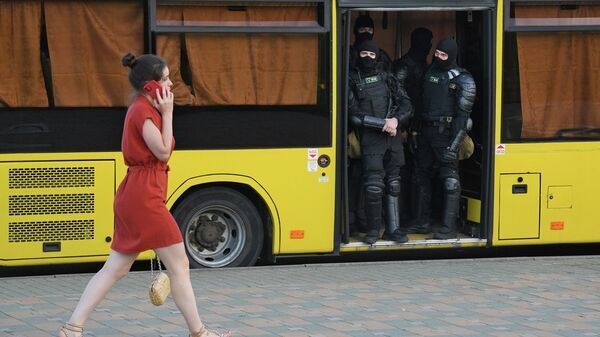
Detained men were brought into the bus all the time. One of them was a UN staff member and the leader of the band Drum Ecstasy, Filipp Chmyr. There were also two ordinary-looking working men who had popped into a nearby store after their shift and were planning to "relax" in nearby Yanka Kupala Park.
Time went by and we got to know each other. It was a respectable crowd: a psychologist, a teacher, a museum employee, a musician, a photographer. Out of boredom I read the children's comics I had with me. We played a word game with city names and guessed what would happen to us next.
Next to me sat a young guy who looked about 16. He was literally shaking with fear, and the stress made him sick, so I gave him the bag from the bookstore, and he used it.
The OMON officers did not respond to any requests or questions. They only threatened us, angrily and with obscenities.
At some point I realized that we were witnesses to a crime, and it would be good to find each other afterward to help with an investigation. So I came up with a hashtag, we used it on social media, and that's how we found each other later.
Several victims identified OMON officers. Besides their commander, Andrey Slyunkov, Roman Torik and Alexander Goncharenok were identified. All of them are suspected of unlawful arrests, threats and beating detainees.
